
AI Crawler Verification: Verify Who Is Really Crawling Your Website
AI crawler verification is the step that checks whether a request claiming to be GPTBot, Googlebot, ClaudeBot, or any other crawler actually comes from the operator it names. A user-agent is a claim, not proof. Across the sites citAEOtion monitors, 842,255 crawler visits had been checked as of October 13, 2026, with 644,960 confirmed as coming from the operator they claimed, and 139,943 visits (as of October 10, 2026) that claimed a trusted crawler identity and failed verification. These are aggregate totals across operator-monitored sites, not typical single-site results.
Quick answer: Your server log shows what each request claims to be. AI crawler verification tests that claim and returns a verdict on every request: verified, impostor, or unverifiable. Detection tools match the name and count every forgery as a real visit. Verification separates the real operators from the requests borrowing their names, which is the only way the rest of your AI visibility data means anything. Roughly 1 in 6 crawler visits on our network claimed a trusted identity and failed verification (October 10, 2026), and in the September 2026 snapshot 32.6% of those forgeries were probing for credentials and configuration instead of reading content.
A User-Agent Is a Claim, Not Proof
Every crawler announces itself with a user-agent string. That string is set by whoever sends the request. Nothing stops a scraper, a scanner, or an attacker from setting it to any value they like, and the names that buy the most trust are the ones they pick.
Google says this plainly in its own documentation: the Googlebot user-agent can be spoofed, and seeing the name in your logs is not enough to confirm the request came from Google. If it is true for Googlebot, it is true for every AI crawler that came after it.
So the honest reading of a raw log is this. You are looking at claimed identities. Some are real. Some are not. The log alone cannot tell you which.
What AI Crawler Verification Means
Verification tests a claimed crawler identity against evidence and returns a verdict on whether the claim holds. The outcome is a status, not a guess:
- Verified: the evidence supports that the request genuinely belongs to the operator it claims.
- Impostor: the request claimed a trusted crawler's identity and the evidence contradicts it.
- Unverifiable: the claim could not be confirmed or denied, so it is never counted as real.
That last line matters more than it looks, and it is worth being precise about what sits in it. Many operators, including Google, Microsoft, OpenAI, Anthropic and Apple, publish a way to confirm that a crawler is theirs. A large number of legitimate tools do not. Most SEO crawlers and social preview fetchers publish no verification method at all, so a request from one of them is unverifiable by definition rather than by suspicion.
A request that cannot be confirmed is therefore not waved through as legitimate, and it is not branded an attacker either. It is held as unproven. That matters because attack traffic hides there too: in the September 2026 snapshot, 13,897 of the 25,420 credential scans we recorded, 54.7%, came from requests in the unverifiable bucket. "Could not confirm" has to mean "do not trust yet," not "probably fine" and not "probably hostile."
Detection Is Not Verification
Most tools that track AI crawlers stop at detection. Detection matches a request against a list of known user-agent patterns and reports "this looks like GPTBot." That is reading the name tag.
Verification checks the badge. It asks whether the request carrying the GPTBot name actually originates with the operator behind that name, and it records the answer.
The difference is not academic. Detection counts every forgery as a real visit, because the forgery carries a real name. Verification is the only layer that separates the two. If your crawler analytics are built on detection alone, every impersonator in your logs is inflating your numbers, and you have no way to see it. For what detection on its own can and cannot tell you, see how to detect AI crawlers on your website.
Verified Versus Claimed Crawler Traffic
Once you split claimed identity from verified identity, the traffic you thought was one thing turns out to be two: the real operators reading your content, and a population of requests that borrowed their names.
The gap between those two numbers is the number no detection tool can show you. It is also the number that decides whether the rest of your AI visibility data is worth acting on. If a meaningful share of your "GPTBot" traffic is not OpenAI, then your read on what OpenAI consumed, and what it might cite, is wrong from the first row.
Real Data From the Sites citAEOtion Monitors
This is not a theoretical explainer. Every claimed crawler identity observed across the sites citAEOtion monitors is tested. Current totals, aggregate across operator-monitored sites: 842,255 crawler visits checked and 644,960 confirmed as coming from the operator they claimed as of October 13, 2026; 139,943 visits that claimed a trusted crawler identity and failed verification as of October 10, 2026. The detailed breakdown below is the September 21, 2026 snapshot, kept so the chart and the numbers match:
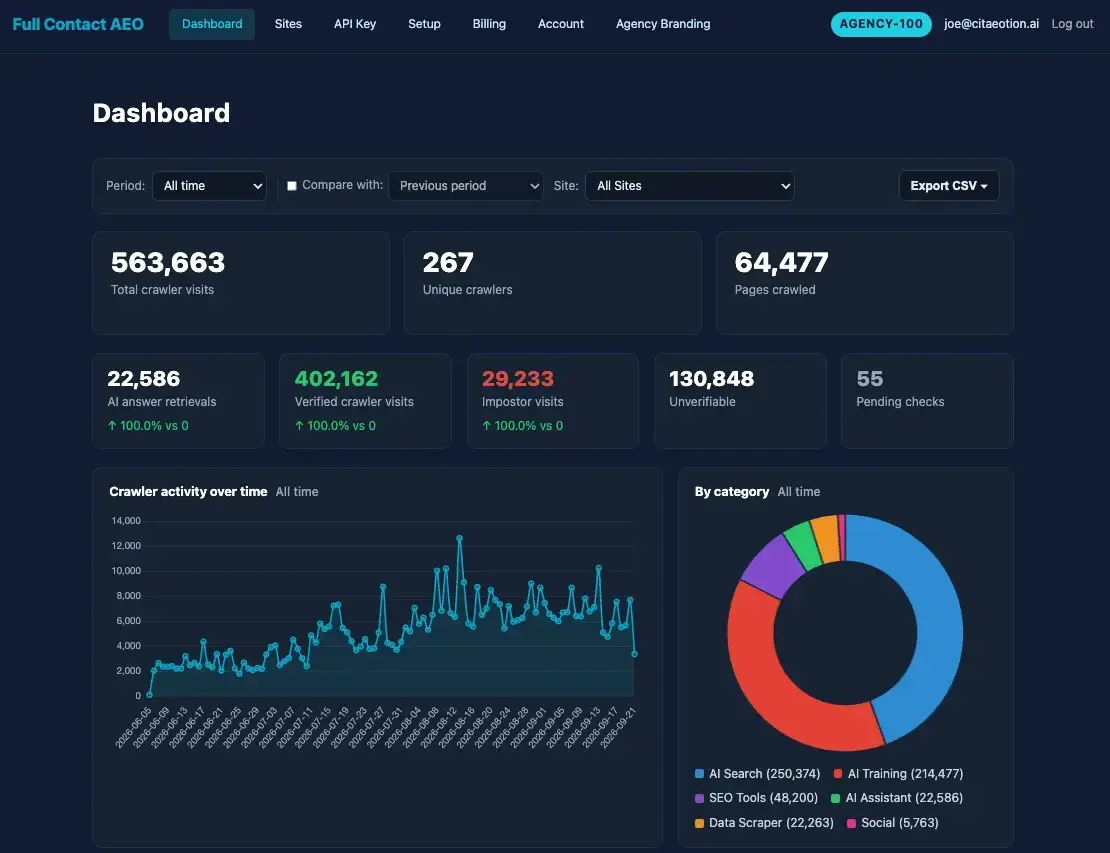
As of 21 September 2026: 563,663 crawler requests observed. 402,162 verified as genuine, 71.3%. 130,848 unverifiable, 23.2%, where no verification method is published or the evidence cuts neither way. 29,233 impostors that failed verification outright, 5.2%. 1,365 suspect, claiming a bot but arriving from hosting infrastructure. 55 still pending. Those buckets sum to the total exactly, because every request gets one verdict and only one. The impostor count has risen sharply since, to 139,943 by October 10, 2026, as verification coverage expanded.
Of the requests that were not verified in that snapshot, 26,945 probed sensitive paths rather than reading content: credential files, cloud metadata endpoints, admin and login pages, path traversal and code execution attempts. Credential and secrets scanning alone accounts for 25,420 of them. Only 4 of those 25,420 scans came from a verified operator, and all four were our own security checks running against our own sites. No third-party verified operator probed for credentials, not once.
The impostors did not arrive anonymously. They wore the identities of trusted crawlers, which is exactly why a system that trusts the user-agent would have logged them as friendly visits from Google, Amazon, and ByteDance. The real operators are welcome. The point of verification is to keep the thousands of requests only pretending to be those operators out of your data and away from your login page.
AI Crawler Impersonation
Impersonation is not a rare edge case. It is a large, steady share of the traffic that claims to be a crawler. An impersonator picks a trusted name precisely because that name buys trust: a request labeled Googlebot gets waved past filters that would stop an unknown bot.
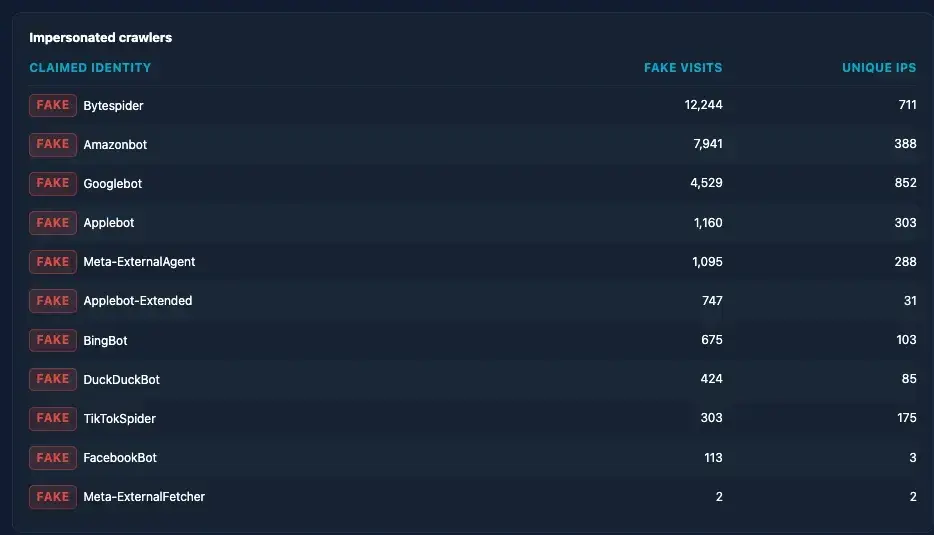
In the September 2026 snapshot, eleven crawler identities had been forged across the sites we monitor, led by Bytespider at 12,244 failed-verification visits, Amazonbot at 7,941, and Googlebot at 4,529. The tail runs down through Applebot, Meta-ExternalAgent, Applebot-Extended, BingBot, DuckDuckBot, TikTokSpider and FacebookBot to Meta-ExternalFetcher, which managed two.
Read the fake-visit count and the unique-IP count together and the shape of each operation shows up. Googlebot is the most widely distributed forgery on the list: 4,529 fake visits spread across 852 separate IPs, which is a botnet borrowing the most trusted name on the web. Applebot-Extended is the opposite: 747 visits from only 31 addresses, a small set of machines hammering one identity. FacebookBot sent 113 requests from 3 addresses. Distribution tells you whether you are looking at a crowd or a crew, and the two call for different responses.
Independent research through 2026 has documented the same pattern on the wider web: requests claiming trusted AI crawler identities that do not originate with the named operators, and tests where most sites let a forged crawler request straight through.
We break impersonation down by the identity claimed, how many requests failed verification under that name, how many distinct sources sent them, and what those requests did after they arrived. The full breakdown, including a credential-scanning burst that rotated Googlebot and BingBot identities for seven minutes, is in our report on fake AI crawlers.
Why Verification Matters to AEO
If you care about AI search visibility, you are already asking which crawlers read your content and whether the models cite you back. You cannot answer that from logs full of forged identities.
Verify every claimed crawler first, separate the real operators from the impersonators, and only then do you have numbers worth acting on. Verified crawl data is also the only foundation the next question can stand on: what did the real crawlers consume, and did that consumption turn into a citation? The impostors are noise in that analysis at best. They do not belong in the metrics you use to make decisions.
Why Verification Matters Beyond Analytics
The same forged identities that pollute your analytics are often doing something worse than scraping. In the September 2026 snapshot, 32.6% of the impostor traffic on our network was not reading articles at all. It was reaching for environment files, configuration files, and other sensitive paths, using a trusted crawler's name as cover. That is 26,945 attack requests wearing crawler identities.
Sorted by intent, and split by what each request turned out to actually be:
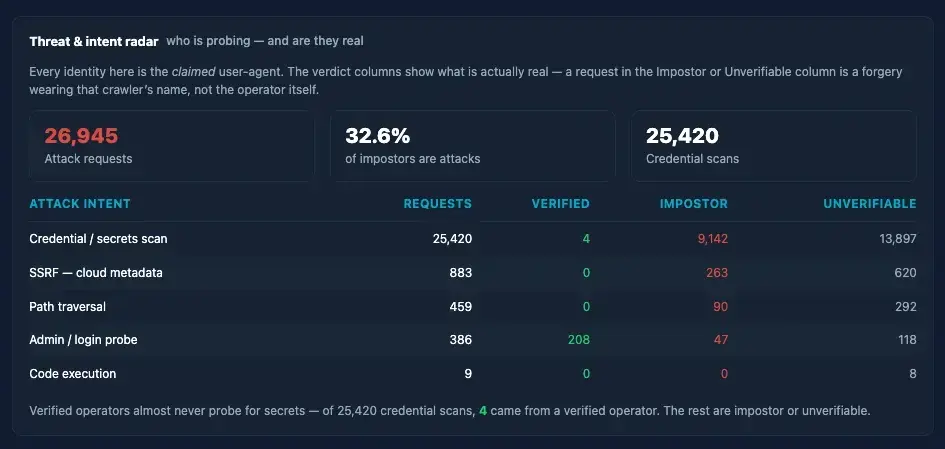
The verified column is the one worth staring at. Across 25,420 attempts to read credential and secrets files, verified operators account for 4 requests, and all four were our own security tooling checking our own sites. Zero verified requests attempted SSRF, path traversal, or code execution. Real crawlers read pages. The things reaching for your .env file are wearing their names.
Verification is what tells the two apart. A request that fails verification and then probes a credential path is a very different event from a genuine crawler indexing your pages, even though both carry the same name in the log. citAEOtion records the claimed identity, the verification verdict, and the behavior as three separate facts, so a forgery is never confused with the operator it imitates, and the operator is never blamed for what a forgery did.
This is not a replacement for your firewall. A WAF decides what to block. Verification tells you whether traffic claiming a trusted identity deserves that trust, and shows you what the real crawlers read versus what the impostors tried.
Which Crawler Identities Are Verified
citAEOtion verifies claimed identities across the major AI and search crawlers, including GPTBot, OAI-SearchBot, ChatGPT-User, ClaudeBot, Googlebot, Bingbot, Applebot, Amazonbot, PerplexityBot, Bytespider, Meta-ExternalAgent, and PetalBot, among others. Each claimed identity is checked and returned with a verdict rather than accepted on the strength of its name. For what each of those crawlers does when it is real, start with GPTBot and ClaudeBot.
Frequently Asked Questions
What is AI crawler verification?
It is the process of checking whether a request that claims to be an AI crawler genuinely comes from the operator it names, and returning a verdict of verified, impostor, or unverifiable. It goes a step beyond detection, which only matches the user-agent string.
AI Crawler Verification - Why can't I just trust the user-agent?
Because the user-agent is set by the sender. Anyone can put "GPTBot" or "Googlebot" in it. Google itself warns that its crawler's user-agent is frequently spoofed. The name in your log is a claim, not evidence.
How is verification different from AI bot detection?
Detection recognizes a known crawler name. Verification tests whether the request behind that name is real. Detection counts a forgery as a visit; verification catches it.
Does a failed AI crawler verification mean the real crawler attacked my site?
No. A failed verification means the request claimed an identity it could not prove. It does not mean OpenAI, Google, or any real operator did anything. Attackers forge those names. Across 25,420 credential scans on our network in the September 2026 snapshot, 4 came from a verified operator and those were our own security checks. citAEOtion reports the claimed identity and the behavior as separate facts and never attributes a forgery's actions to the operator it imitated.
AI Crawler Verification - What does "unverifiable" mean?
The request claimed a crawler identity and the evidence could neither confirm nor contradict it. Often that is because the operator publishes no way to confirm its traffic: most SEO crawlers and social preview fetchers offer none, so their traffic is unverifiable by design rather than by suspicion. It is held as unproven and never counted as verified. Attack traffic hides in this bucket too, 13,897 credential scans came from it in the September 2026 snapshot, which is why an unconfirmed claim is treated with caution rather than trust.
Which crawler identity gets forged most?
In the September 2026 snapshot, by volume, Bytespider: 12,244 failed-verification visits from 711 distinct addresses. By distribution, Googlebot: 4,529 fake visits spread across 852 separate IPs, more unique sources than any other forged identity on our network.
Do I need this if I already have a WAF or bot manager?
Verification answers a different question. A WAF decides whether to block traffic. citAEOtion tells you whether traffic claiming a trusted crawler's identity actually deserves that trust, and shows you what the real crawlers read versus what the impostors did.
How much does it cost?
Verification is included in every citAEOtion plan. Single-site tracking is a one-time $99 for life, and agencies can track every client site under one account with white-label reporting.
Stop Trusting the Name. Start Verifying the Crawler.
Track who claims to crawl your site. Verify who is actually behind the request. See what verified crawlers consume and what impersonators do.
See Which AI Crawlers Are Actually Real Or book a 20-minute walkthrough on your own site
AI Crawler Verification: Verify Who Is Really Crawling Your WebsitecitAEOtion2026-10-16T20:57:12-04:00