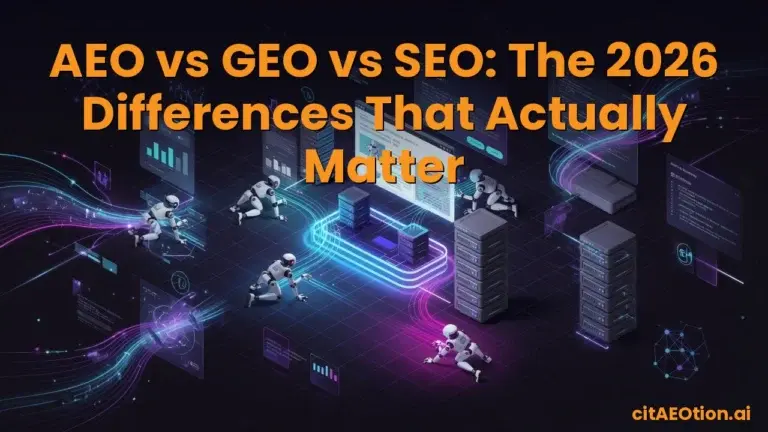
AEO vs GEO vs SEO: The 2026 Differences That Actually Matter
SEO ranks links, AEO wins the answer box, GEO wins the sentence an AI writes about you. Clear definitions, when each matters, and how to measure crawler access in 2026.

SEO ranks links, AEO wins the answer box, GEO wins the sentence an AI writes about you. Clear definitions, when each matters, and how to measure crawler access in 2026.
Google Analytics cannot show which AI bots crawl your site. Server logs can. Here is how to read them and what a log-based dashboard reveals.
Google-Extended is a robots.txt control token that decides whether your Google-crawled content can be used for Gemini AI, and it is not a separate crawler with its own user agent. Google-Extended is a robots.txt token, not a crawler. It has no user agent and fetches nothing. It only tells Google whether content already crawled by […]
Automated traffic now exceeds human traffic, AI crawlers make up nearly 80% of AI bot activity, and GPTBot leads AI-only crawlers. Every figure cited to Cloudflare, Fastly, and Imperva.
You cannot improve what you cannot measure. Prompt sampling is noisy; server-log crawler data is ground truth. What to track, and how citAEOtion reports it.
The top AI crawlers in 2026 are GPTBot (OpenAI), ClaudeBot (Anthropic), Meta-ExternalAgent (Meta), GoogleOther, Amazonbot, PetalBot, and PerplexityBot. Knowing the name is the easy part; what each bot does on your pages is what matters - and bots now make up 57.5 percent of web traffic. Quick answer: A bot's name tells you who owns […]
TLDR: The citAEOtion Collector is a WordPress AI crawler tracking plugin you install in about five minutes to log every AI bot at the server level and sort it by what each one wants. The citAEOtion Collector is a WordPress AI crawler tracking plugin that installs in about five minutes: upload it, activate it, paste […]
Generative engine optimization is structuring content so AI engines pull it into the answers they generate, instead of fighting only for the ten blue links. SEO wants you in the list; GEO wants you in the answer - and AI crawlers do not render JavaScript, so server-rendered content is the floor. Quick answer: Generative engine […]
Knowing whether AI is citing your website means separating reading - an AI crawler like GPTBot requesting your page - from citing, where an answer engine names you as a source in its reply. Bots now make up 57.5 percent of web traffic, and a site can be read constantly yet cited never, so you […]
White label AI crawler reports turn real server-level bot activity into a branded client document showing which AI crawlers hit which pages, how often, and the trend - not a prompt-based guess. With bots now 57.5 percent of web traffic, a report that counts only human visits covers the minority. Quick answer: A white label […]
AI crawler insights are a fact from your server logs plus the decision it points to: which AI bots read you, what they took, and what to change. Training drove nearly 80 percent of AI crawling by mid-2025, so most bot activity on your site is feeding models, not answering live queries. Quick answer: An […]
Answer engine optimization (AEO) is structuring content so AI engines like ChatGPT, Gemini, and Perplexity read, trust, and cite it. SEO wins when you rank; AEO wins when you become the answer - and AI-search visitors converted at 4.4 times the rate of organic in a 2025 Semrush analysis. Quick answer: Answer engine optimization gets […]
AI crawler dashboard metrics are the per-crawler visit counts, page-level hits, response codes, and trends your server records for bots like GPTBot and PerplexityBot. A raw count means nothing until each bot is sorted by purpose - and bots now make up 57.5 percent of web traffic. Quick answer: AI crawler dashboard metrics only become […]
Analyzing AI crawler visit patterns means reading your server logs to see which AI bots fetch which pages and how often. A Duda study of 858,457 sites logged 68.9 million AI crawler visits in February 2026, with OpenAI's GPTBot driving 81 percent of them. Quick answer: To analyze AI crawler visit patterns, read your server […]
AI crawler analytics reads your server records to show which AI bots requested which pages, how often, and what they got back. The scale is real: AI crawlers make roughly 1.3 billion fetches a month, about 28 percent of Googlebot's volume, and most do not run JavaScript. Quick answer: AI crawler analytics turns raw bot […]
AI crawler tracking is reading your server logs to see which AI bots - GPTBot, ClaudeBot, PerplexityBot - requested which pages and when. Browser analytics miss them entirely: Vercel found no JavaScript execution across 500 million-plus GPTBot fetches, so your tracking pixel never fires. Quick answer: AI crawler tracking happens at the server level, not […]