
Copilot Citations Case Study: Two Algorithm Changes, Two Recoveries
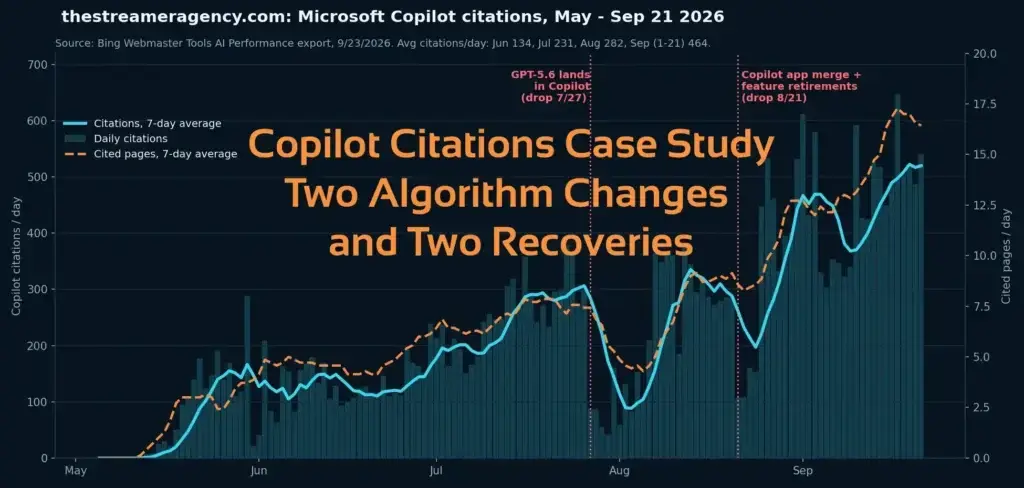
Copilot citations for one of our sites dropped twice this summer, both times right after a documented Microsoft Copilot change. Both times we spotted it in the data, found out what Microsoft had changed, reworked the site for the new model, and came back higher than before.
This Copilot citations case study follows thestreameragency.com through two Microsoft Copilot changes in summer 2026: GPT-5.6 landing in Copilot in late July, and the Copilot app merge and feature retirements in mid-August. Citations fell 64% after the first change and 58% after the second. Each time, the drop showed up in the data, we researched what changed, and we reworked the site for what the new model was looking for. The site recovered in 11 days, then in 4 days. By mid-September it was earning 62% more Copilot citations per day than before the first drop, from twice as many pages.
Quick answer: Microsoft Copilot changed twice in four weeks. OpenAI's GPT-5.6 finished rolling out in Copilot on July 24-26, 2026, and Microsoft merged its Copilot apps and retired features including Deep Research effective August 18. On thestreameragency.com, Bing Webmaster Tools shows citations dropping on July 27 and again on August 21. The site recovered both times and settled higher: from 300 citations a day in mid-July to 485 a day in mid-September, with cited pages going from 7.6 a day to 15.7. Every number here comes from Bing's own AI Performance export.
What happened, in one chart
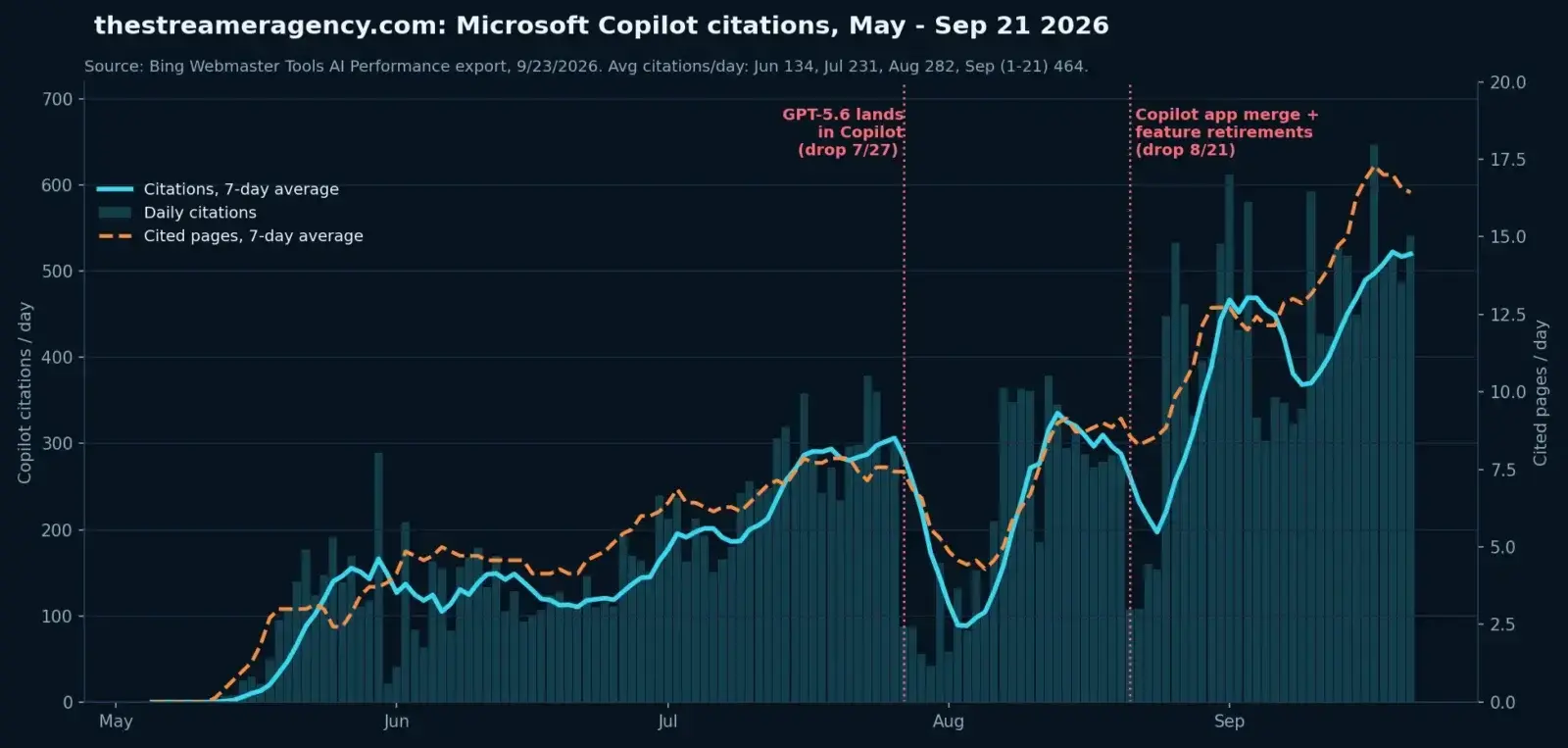
The blue line is daily Copilot citations, smoothed to a 7-day average. The orange dashed line is how many different pages Copilot cited each day. The two red markers are the two Copilot changes. The data is from Bing Webmaster Tools, exported on September 23, 2026.
Look at the shape. A steady climb through July. A sharp V at the end of July. A second, shorter V in late August. Then a breakout to the highest level the site has ever had.
Change one: GPT-5.6 lands in Copilot
In early July, OpenAI and Microsoft announced GPT-5.6 as the preferred model in Microsoft 365 Copilot (OpenAI, Microsoft). The rollout finished on July 24-26 (A Guide to Cloud & AI).
On July 26 the site earned 301 citations. On July 27 it earned 88. The low point was July 30, at 42.
- Before the change (July 13-26): 300 citations a day, 7.6 pages cited a day.
- The drop (July 27-August 6): 107 a day. Down 64%.
- The recovery (August 7-20): 312 a day, with 9.1 pages cited a day. Back to even on citations, 20% more pages.
Eleven days from drop to recovery.
Change two: one Copilot app, fewer features
In mid-August, Microsoft started merging its consumer Copilot app and Microsoft 365 Copilot into one app called Microsoft Copilot (Redmondmag, GeekWire). Microsoft's support documentation lists Group Chat, Podcasts, and Deep Research as retired from the consumer app effective August 18 (Microsoft Support). The official Microsoft 365 Copilot release notes cover a batch of updates released between August 11 and August 25.
Deep Research was one of the most citation-heavy features in Copilot. Three days after it was retired, the site's citations dropped again.
- Before the change (August 7-20): 312 citations a day.
- The drop (August 21-24): 132 a day. Down 58%. August 21 came in at 107.
- The recovery started August 25, the last day of Microsoft's release window, at 448.
- After (August 25-September 21): 459 a day, and 14.2 pages cited a day.
Four days from drop to recovery. And this time the site didn't just come back. It climbed 47% above where it was before the change.
How we recovered, twice
Nothing on the site broke. Microsoft changed what Copilot was looking for, and the site's content was still built for the old version. Both recoveries followed the same four steps.
1. The data showed it first. We watch Copilot citations every day next to our citAEOtion crawler data. On July 27, citations fell from 301 to 88 overnight. A one-day wobble happens. A 70% drop that holds for a second day is a signal. We knew something had changed within a couple of days.
2. We found out what changed. We went to the sources: Microsoft's release notes, their support documentation, and OpenAI's announcements. In July, the answer was a new model, GPT-5.6, now answering questions inside Copilot. In August, it was the app merge, the retired features, and a new model lineup. A new model doesn't read the web the same way the old one did. It prefers different things in the pages it picks.
3. We used the data to make an educated guess, then reworked the whole site. Microsoft doesn't publish what a new model wants. But citAEOtion showed us which AI bots were reading which pages, before and after the change. Put that next to Microsoft's release notes and you can make an educated guess about what the new model is looking for. We made that call and changed the content across the whole site to fit it. Not one page. Every page. The first time, that took eleven days from the drop to recovery.
4. The second time, we were ready. By August we knew the pattern. When Microsoft's next wave of Copilot changes started rolling out, we were already watching the release notes. When citations dipped on August 21, we knew what to look for and how to adapt. Four days later the site was back. Its first two weeks after recovery averaged 39% above the level before the change, and by mid-September it was running 56% higher.
That's the part most site owners never get to. They don't see the drop until weeks later, and by then they're guessing with nothing to go on. Data first, then research, then adapt. Every step starts with seeing it happen.
"I used the data from citAEOtion to make an educated guess about what the new model needed, made those changes, and came back stronger than before. Without citAEOtion, I would have flatlined."
- Joe Harvey, founder of citAEOtion and owner of thestreameragency.com
The full picture
Put mid-July next to mid-September and the change is hard to miss:
- Daily Copilot citations: 300 to 485. Up 62%.
- Pages cited per day: 7.6 to 15.7. About double.
- Peak day: 647 citations on September 17. Peak spread: 23 different pages cited on September 15.
- Monthly: July averaged 231 citations a day, August 282, and September's first three weeks 464. The first 21 days of September brought in 9,753 citations, more than all 31 days of August (8,738), which had both drops in it.
The page count matters as much as the citation count. More pages cited means Copilot is trusting more of the site, not just leaning harder on one article.
Where the new citations came from
Bing's page and query reports show the growth came from topics Copilot hadn't used the site for before. Comparing July 24-September 21 against May 24-July 24:
- Total citations: 11.3K to 19.9K. Up 76%.
- "how to become a streamer": 5 citations to 796.
- Three TikTok Live questions ("how to leverage tiktok live streaming", "best tiktok live stream tips", "how to start a successful tiktok livestream"): 0 citations to 1,271 combined.
- The TikTok Live streamer guide page: 37 citations to 2,300.
- Two monetization guides that had never been cited: 0 to 600, and 0 to 367.
The questions that were already strong stayed about the same. The growth was new ground.
What this means for your site
AI engines are going to keep changing. New models, merged apps, retired features. Each one reshuffles which sources get cited, and most site owners find out weeks later, if they find out at all. Four habits made the difference here.
Watch it daily. A 64% drop that lasts eleven days is a disaster if you notice it on day thirty. Bing Webmaster Tools' AI Performance report shows Copilot citations by day, page, and query. Check it the way you check rankings.
Match drops to dates. Both drops here lined up with public changes you can read about in Microsoft's release notes and support docs. When your numbers move, check what shipped that week before you start guessing.
Adapt to the new model, fast. When the engine changes, the content that worked last month may not be what it wants now. Find out what the new model looks for, then rework your pages to match. The sooner you do it, the shorter the drop.
Know who is reading you. Citations are the outcome. Crawler activity is what comes before it. citAEOtion reads your real WordPress server traffic and shows which AI crawlers fetch which pages, verified and classified, so you can see how AI engines are treating your site before the citations show up, or disappear.
The exact changes we made for each model are what we teach our customers inside citAEOtion. The results are what you see above.
Frequently Asked Questions
What are Copilot citations?
A Copilot citation is when Microsoft Copilot links to your page as a source in an answer. Bing Webmaster Tools reports them in its AI Performance section, covering Microsoft Copilot and partners, with daily totals, cited pages, and the questions that triggered them.
Why did Copilot citations drop in late July 2026?
For this site, the drop started July 27, the day after OpenAI's GPT-5.6 finished rolling out in Copilot on July 24-26. A new model can change which sources get picked for answers. We can show the timing lines up. We can't see inside Microsoft's systems to prove the exact cause.
Why did Copilot citations drop in August 2026?
The second drop started August 21, during Microsoft's August 11-25 release window. That window included merging the Copilot apps and retiring features, among them Deep Research, which was retired effective August 18.
How fast can a site recover from a Copilot change?
Here, the first recovery took 11 days and the second took 4. Both times we researched what Microsoft changed and reworked the site's content for the new model. Both ended at or above the level before the drop. Results depend on the site, its content, and the change.
What did you change to recover?
Both times, we used citAEOtion's crawler data alongside Microsoft's release notes to make an educated guess about what the new model was looking for, then reworked the content across the whole site to fit it. The specific changes are part of what we teach citAEOtion customers.
Can I see my own Copilot citations?
Yes. Verify your site in Bing Webmaster Tools and open AI Performance. For the crawler side, which AI bots actually read your pages, citAEOtion shows it from your server traffic.
Data: Bing Webmaster Tools AI Performance export for thestreameragency.com, downloaded September 23, 2026. Bing notes this data is a sample of overall activity and may be refined. One site; your results will vary. thestreameragency.com is owned by citAEOtion's founder.
See every AI crawler on your site: $99 Lifetime Deal
Copilot Citations Case Study: Two Algorithm Changes, Two RecoveriescitAEOtion2026-11-02T02:05:27-05:00